Remembering a Draft Dodger
“Believe me,” I say to the Generation X-er, taking note of her indifference, “I never looked at the world as being my oyster. As a matter of fact, I was repeatedly reminded as a child that the world didn’t revolve around me.” Immediately I self-analyze my use of this cliché as egocentric.
She casually flips her hair and gives me an irritated half-smile without comprehending the point, the issue of self-absorption. “It’s like every man for himself these days,” I inexplicably cliché once more.
BABY BOOMER: Typically those born between 1946 and 1964.
Years before I was born, my father came home a hero after serving overseas for four and a half years, as did every U.S. and Canadian soldier who left their family during the Second World War to fight for our freedom and were fortunate enough to survive.
THE GREATEST GENERATION: A term coined by Tom Brokaw referring to those living during the Great Depression and the Second World War. The parents of Baby Boomers.
Which brings me back in a roundabout way to my conversation with the Generation X-er.
“I’m planning on writing a novel that includes a Vietnam War draft dodger. I met quite a few of them when I hitchhiked across the country as a teenager.”
“Draft dodgers? Vietnam?”
I wonder if I should simply leave the subject alone. I can see her try to hold back an outright laugh at the image of me hitchhiking, or perhaps young, or perhaps a war she’d learned nothing about and obviously didn’t care to.
“They opposed the Vietnam War. And they came to Canada from the States. The ones who did serve in Vietnam came home maimed one way or another to no fanfare, no ticker tape parades, and no hero status, even if they had earned medals.”
“Hell,” she says, drumming fingertips on the table. “We’ve got our own wars to think about.”
GENERATION X: Typically birth years from the mid-1960s to the late 1970s or early 1980s.
“And if you really want to write about medals and stuff, take a look at the Millennials,” she says. “The way they were raised, they got medals just for showing up.”
MILLENNIALS: No precise birth years, but typically the early 1980s to the mid-1990s or early 2000s.
Most of the guys I met who dodged the U.S. draft I encountered in Jasper, Alberta, in the 70s when opposition to conscription was still going on. Averted from the road by hippie word of mouth, my best friend and I headed to a shallow valley just a short walk from the town, crossing Highway 16 during a pause between whizzing vehicles. A faint trail stamped to a flat pathway by innumerable footsteps led us down a thickly-treed slope that opened to a field of sorts, although trees and tents were spattered here and there.
We set up our tent along the pristine Athabasca River that flowed in a snakelike manner beneath snow-crested mountains. At nightfall, everyone gathered around campfires engulfed by darkness the blackest I’d ever known. Peace resonated as a palpable symbol of the time. Cloaked in guitar chords, voices belted out protest songs like “Give Peace a Chance” and “Bring ‘Em Home”.
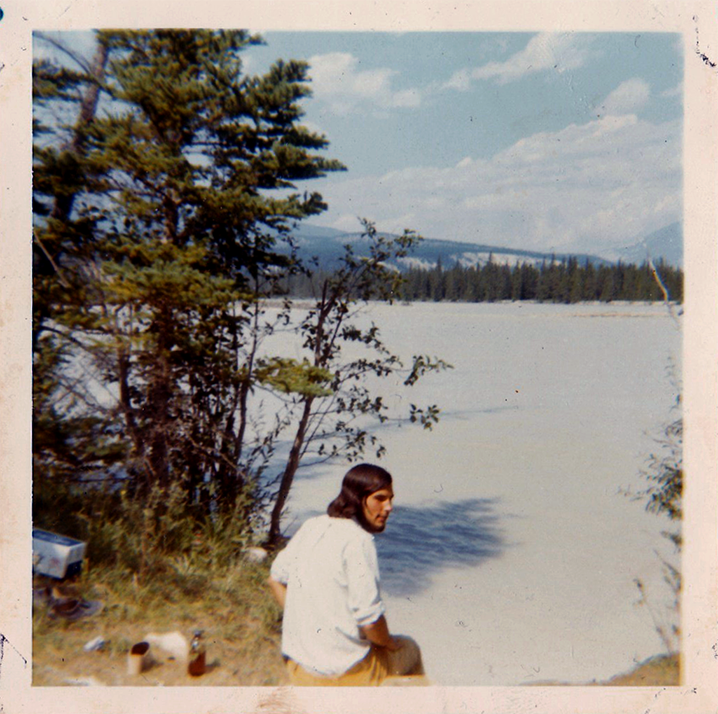
One day as the others indulged themselves in an afternoon of skinny-dipping, I trekked about the valley ... and that’s when I discovered him. As he stared down the river like he was scrutinizing the current, I was drawn to his solitude, and perhaps the reason I felt the need to record it.
We had a few conversations during the weeks he camped in the area, although I can’t remember for certain which state he said he was from (I think it was California) or anything regarding the life he left: family, friends, pet, bed. He never mentioned a girlfriend, that I’m sure of. I tried my best to get him to open up, but it was difficult. He resisted my queries as if defending himself by avoidance. Of course, there could be no authentic understanding on my part regarding what he was going through. My home was a bungalow in a suburb of Toronto waiting for me without reprisal.
Sometimes I think of how difficult it must have been for my father to adjust to a life of normalcy after years of witnessing the horrors of war. But then I remember the day, as a little girl, when pipers decked in Tartan kilts with leather sporrans paraded down my street. I don’t know why years after the Second World War they exhibited this show of fanfare, although my father being a career soldier must have had something to do with it. But I recall the moment as if it happened recently, seeing our neighbors rush from their homes to stand on porches or line the roadway to cheer and applaud.
The U.S. soldiers of the Vietnam War never received such adulation.
As I write this, I have the page of my photo album open to this photo. My new acquaintance sits on the sparsely-grassed ledge, forever youthful, feet dipped in the river. His thick dark hair falls to his shoulders and a beard stretches across the chin of his handsome face. I can’t help but wonder where he ended up.
“Would you like me to tell you a bit about the Vietnam War?” I ask the Generation X-er.
Approximately sixty thousand U.S. soldiers were killed in action. On January 21st, 1977, President Jimmy Carter offered a full pardon to any draft dodger who requested one. Of the tens of thousands of draft dodgers who came to Canada, many stayed, although no government records were kept.
“Really?” she says. “I had no idea.”
If this resonated with you, explore more in my book The Somewhere I See You Again, your support means the world to small authors.